Troubleshooting Flavor
Recognizing and Reducing Uneven Coffee Extraction
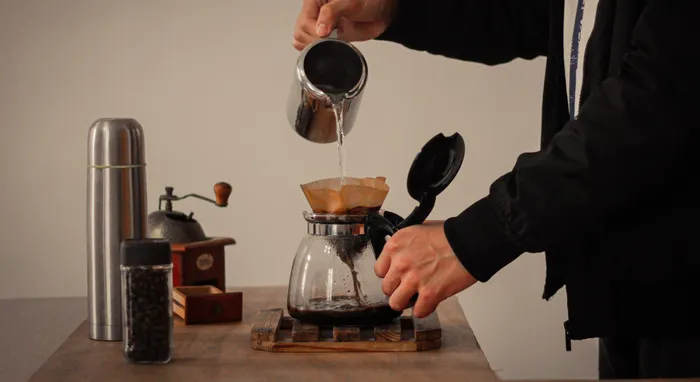
Uneven extraction occurs when some coffee particles give up far more soluble material than others. The cup may taste sour and bitter at the same time, seem hollow despite a long brew, or produce a dry finish that does not respond predictably to grind changes. Unevenness often comes from particle variation, incomplete wetting, or water finding preferred paths.
In pour-over brewing, inspect the process rather than judging the final bed as a beauty contest. Dry pockets during the initial pour, water repeatedly striking one spot, or liquid escaping along the filter wall can create different extraction zones. Wet all grounds during the bloom, pour with controlled coverage, and keep the brewer level. Excessive swirling or stirring can move fine particles downward and stall flow.
Automatic drip brewers depend on their spray pattern. Level the grounds without packing them and confirm removable spray components are clean. A machine may brew poorly when used far below its normal batch range because water reaches only part of a shallow bed. Follow the manufacturer's capacity guidance and compare a suitable batch before replacing equipment.
Espresso channeling is a concentrated form of uneven flow. Clumps, an unlevel tamp, a wet basket, or coffee distributed densely on one side create weak paths. Break up obvious clumps with an appropriate clean tool, distribute evenly, tamp level, and clear the basket rim. Do not compensate by tamping with extreme force or exceeding the basket's intended dose.
Immersion methods are naturally less sensitive to channeling, but dry floating clumps and a very inconsistent grind still matter. Stir gently enough to saturate all coffee. When pressing or filtering, avoid squeezing sediment through the screen. Decant the beverage so settled fines do not continue affecting the final cup.
Grinder performance deserves attention. Burrs or grinding surfaces packed with residue can produce irregular output, and damaged parts may need replacement. Even a good grinder creates some fines. Avoid repeatedly regrinding particles or shaking fine powder through a household sieve unless using a tested method; those steps add inconsistency and waste.
Use visual clues alongside taste. Espresso spraying from a bottomless portafilter can reveal channeling but also creates hot splashes and should be used only with appropriate equipment and protection. Pour-over drawdown that suddenly accelerates or stalls provides another clue. A muddy bed alone does not prove failure because coffees and grinders differ.
Test one correction at a time. Improve initial wetting, then compare. Level the bed, then compare. Clean the grinder, then return to the previous setting and observe. If every variable changes together, a better cup cannot teach the brewer what worked.
Perfectly uniform extraction is unrealistic. The practical goal is to remove large differences that create conflicting flavors. Consistent particles, complete wetting, a level coffee bed, controlled agitation, and equipment used within its intended range make the cup easier to adjust and repeat.
Uneven extraction becomes easier to spot when the baseline is written. Record the normal drawdown or shot behavior without treating it as a rigid target. A sudden change with the same coffee can indicate grinder drift, a clogged filter, altered pouring, or a dose error. Compare the process notes before making a permanent adjustment to equipment.