Coffee Fundamentals
Understanding Grind Size Without Memorizing a Chart
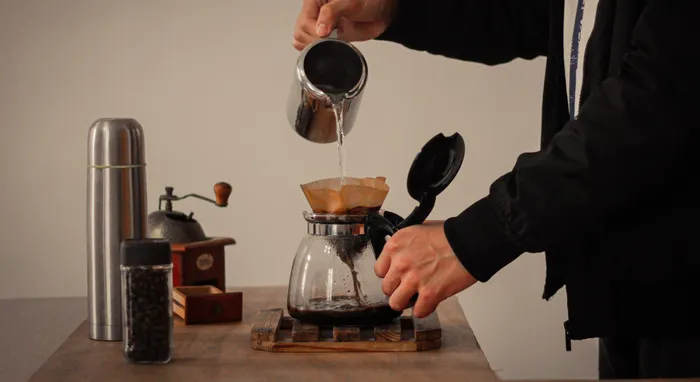
Grind size controls how much surface area water can reach and how easily water moves through a bed of coffee. Finer particles expose more area and create more resistance; coarser particles expose less area and usually allow water to pass more freely. Those relationships matter more than labels such as fine, medium, or coarse, which differ among grinders and photographs.
Begin with the brewing method. A short contact-time method usually needs a finer grind than a long immersion. A paper-filter drip brewer often starts near the middle of a grinder's range, while a French press commonly uses a coarser setting. These are starting points, not fixed rules. Filter shape, batch size, pouring pattern, bean density, and grinder design all affect the useful setting.
Use taste and brew behavior to adjust. Coffee that tastes sharply sour, thin, or undeveloped may be under-extracted. If the recipe and water are otherwise stable, grinding finer increases extraction. Coffee that tastes harsh, drying, or persistently bitter may be over-extracted or unevenly brewed; a coarser grind is one possible correction. Flavor words are subjective, so combine taste with observations such as an unusually fast or slow drawdown.
Change the setting in small steps. Large jumps make it easy to move past a balanced range. Keep the coffee dose, water amount, temperature, and technique the same for the next brew. Record the grinder setting using the machine's own numbers or clicks, even though those numbers cannot be compared directly with someone else's grinder.
Particle consistency matters alongside average size. A grinder can produce both dusty fines and large fragments, which extract at different rates. Some variation is unavoidable. Clean burrs or grinding parts according to the manufacturer instructions, avoid overfilling beyond the machine's intended use, and replace damaged components when appropriate. Buying a new grinder should follow a demonstrated need, not the assumption that equipment solves every brewing problem.
Different beans may require a different setting. A light, dense coffee can behave differently from a darker, more brittle roast. As beans age, the setting that once tasted balanced may need adjustment. The same grinder also changes slightly after cleaning or when switching between a very small and large dose.
For blade-style grinders, use short pulses and gently shake the closed unit between pulses to reduce obvious size differences, following all safety directions and never reaching into the chamber while connected to power. The result will still be less uniform, but a consistent routine makes adjustments possible.
The useful grind is the one that produces balanced flavor with a repeatable recipe. Treat method labels as a first estimate, then let drawdown, contact time, and taste guide the final setting. That approach transfers to any grinder without depending on a misleading universal chart.
Calibrate the language with real grounds. Place small samples from three neighboring settings on white paper, label them, and compare the visible spread without rubbing particles between fingers near food. Brew the middle setting first. If the next correction helps, retain a reference note or photograph. The exercise links the grinder's controls with observed brewing behavior instead of an online image made with different equipment.