Coffee Fundamentals
Coffee-to-Water Ratios Made Practical
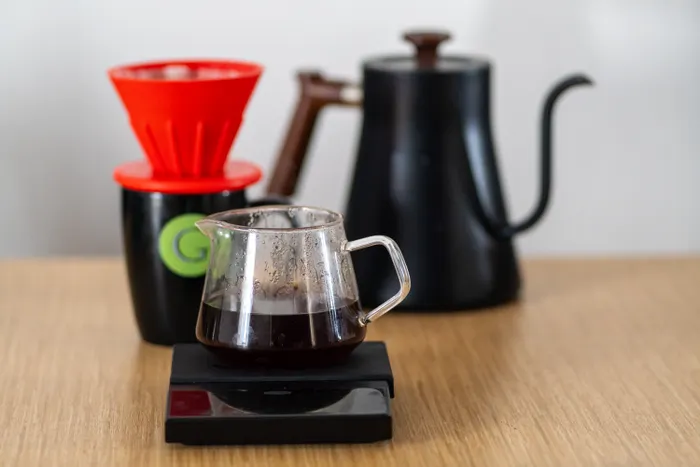
A coffee-to-water ratio describes a recipe in a way that works across cup sizes. It prevents vague instructions such as “two scoops” from changing whenever the scoop, bean, or mug changes. The ratio is not a quality score and does not have one perfect value. It is a stable starting point that makes deliberate adjustment possible.
Use weight when available. A basic kitchen scale can measure beans and brewing water in grams, allowing the same recipe to be repeated without converting between volume units. Water is convenient to measure this way because one gram is approximately one milliliter for ordinary brewing purposes. Place the brewer and vessel on the scale, tare it, add coffee, tare again if useful, and add the planned water.
Many home brewers begin somewhere around one part coffee to fifteen or seventeen parts water. That broad range is a starting zone rather than a rule. A recipe using twenty grams of coffee and three hundred grams of water has a one-to-fifteen ratio. The same relationship can be scaled to another batch by multiplying the coffee weight by fifteen. Immersion, drip, concentrated, and iced methods may use different strengths and account for retained water or added ice.
Distinguish strength from extraction. Strength describes how concentrated the beverage tastes. Extraction describes how much soluble material water removed from the grounds. Adding more coffee with the same water generally makes a stronger drink, but it does not automatically correct sour or bitter extraction. Grind size, contact time, agitation, temperature, and pouring also shape the result.
Choose one baseline and brew it several times. If the method tastes balanced but too intense, use slightly more water or less coffee while preserving the other variables. If it tastes balanced but weak, do the reverse. If it tastes sour, drying, hollow, or harsh, investigate grind and technique before making a large ratio change. Adjustments should answer one sensory problem at a time.
Volume measures can work when a scale is unavailable, but coffee density varies by roast and bean, and tablespoons are not always filled consistently. Use the same level measure each time and mark the water line on the brewer or carafe. The recipe will be less transferable, yet it can still be repeatable within one kitchen.
Account for the actual output. Ground coffee holds some water, and an automatic brewer may leave water in its system. If the goal is a full travel mug, measure the brewed yield once and adjust the input without exceeding the equipment's safe capacity. Never defeat a fill line or overflow protection to reach a target volume.
Write the chosen ratio beside the grinder setting and method. With those two anchors, a household can scale a recipe, compare beans, and troubleshoot without starting over. The best ratio is the one that creates the preferred strength while leaving room to correct extraction separately.
Ratios also make communication easier. If two household members brew, a note stating coffee and water weights is clearer than “make it the usual way.” Store the recipe near the brewer and include the intended batch. When changing coffees, keep the ratio for the first attempt. This isolates bean behavior from strength preference and gives later adjustments a known reference.